
Following Hoke County Recent Arrests
Hoke County publishes no booking roster on the open web. The Detention Center page sends people to its information line. Staff there can cover charges, bond, and release conditions. For a fresh booking, that phone line beats everything else. The sheriff's office also offers an app with an inmate-search feature. Its store listing promises no photos and names no refresh schedule. Press releases and patrol logs cover selected events, not a full count of who was arrested in Hoke County. That gap shapes how a search should work. An empty result online proves nothing, since arrest data may simply live offline. Start with official channels. Note the date and time of every check. Then compare the name against a court file once a case exists. Booking records show the arrest moment. They do not show the end of the story. Define "recent" before you dig. A person booked this morning may still be moving through intake. Someone arrested yesterday might have posted bond already. The app tracks jail custody, so it fits best once a person has actually been housed. Detention staff can explain a current charge or a release condition. The arresting agency handles the incident report itself. After a case is filed, the court calendar and Portal take over. Those records should agree on identity even when their statuses lag behind each other.
| Window | Best Hoke County route | What to expect |
|---|---|---|
| Same day | 24 Hour Arrests | App inmate search, detention-center call, then a focused records request |
| Several days | Arrest Log | Patrol logs, agency news, court activity, and retained records, not a complete county feed |
| Ongoing custody | VINELink Check | One-person custody search and optional notifications, subject to reporting lag |
Arrested Last Night in Hoke County
Try the Hoke County Sheriff's Office app first when a phone search is easiest. It points you toward current custody, though it won't hand you a full arrest history. For a direct answer, call the Hoke County Detention Center at 910-875-5113. Staff there give the public details on inmate charges and release conditions, per the official page. A county guide from 2024 posted a shorter weekday phone window than the live page shows. So call inside the overlap. Let staff set the rules. Timing matters too. Someone processed very recently may not appear in any public system yet. Intake delays and identity checks can hide a name for a while. So can early release or a transfer. NC SAVAN cautions about one gap. A person released at the magistrate level without a jail booking never enters its monitoring system at all. Give the agency a full legal name and a useful date. Even then, a missing result is not a clean record. Watch out for false matches. Common names, odd spellings, suffixes, and changed last names cause trouble. They can send you to the wrong person. Before you trust a hit, confirm one more detail through an official source. Options include a birth date, booking date, case number, or arresting agency. Use them when lawfully available. A photo alone proves nothing. A bad copy might be old, cropped, or tied to a different arrest altogether. If safety or a welfare concern drives the search, call the right public agency. Do not wait on a website.
The Hoke County Arrest Roster
The Hoke County Detention Center sits at 125 E. Edinborough Avenue and answers to the Sheriff's Office. No online roster appears on the county's pages. Instead, the office publishes a jail-information phone line. Hours differ between sources, too. The live county page posts 8 a.m. to 5 p.m., Monday through Saturday. The visitor guide says 8 a.m. to 3 p.m., weekdays only. Treat the live page as the first reference, and let staff confirm the current window.
One digital channel is documented. The store listing for the official Hoke County Sheriff's Office mobile app says plainly that users can search inmates. What a result contains is left open, though. The listing never promises a booking number, bond, release date, or photo, so confirm the key facts by phone.
The app listings also describe sex-offender lookup, tips, permit details, and public-safety news. Those tools are not one arrest database. A news notice describes an investigation. A tip form collects information. An inmate result concerns jail custody only. The listings warn that the app is not for emergencies. If the inmate screen fails, changes format, or shows no match, call the published jail line rather than an unofficial mirror. Phone confirmation matters most before travel, visitation planning, or support for someone who may have been released or transferred.
| Search detail | How it helps |
|---|---|
| Full legal name | Separates people with similar names and reduces false matches |
| Approximate booking date | Helps staff narrow a recent intake |
| Date of birth | Useful identity check when law and policy allow disclosure |
| OCA or case number | Connects a later records request with the agency event |
| Arresting agency | Distinguishes Raeford Police activity from Sheriff activity |
- Try the official sheriff app's inmate-search feature.
- Call the detention center for charge and release-condition information.
- If the person is no longer held, ask the arresting agency for the retained booking or arrest record.
- Use the Hoke court portal or clerk records to find the later disposition.
The official Detention Center page shows the county's inmate-information instructions.
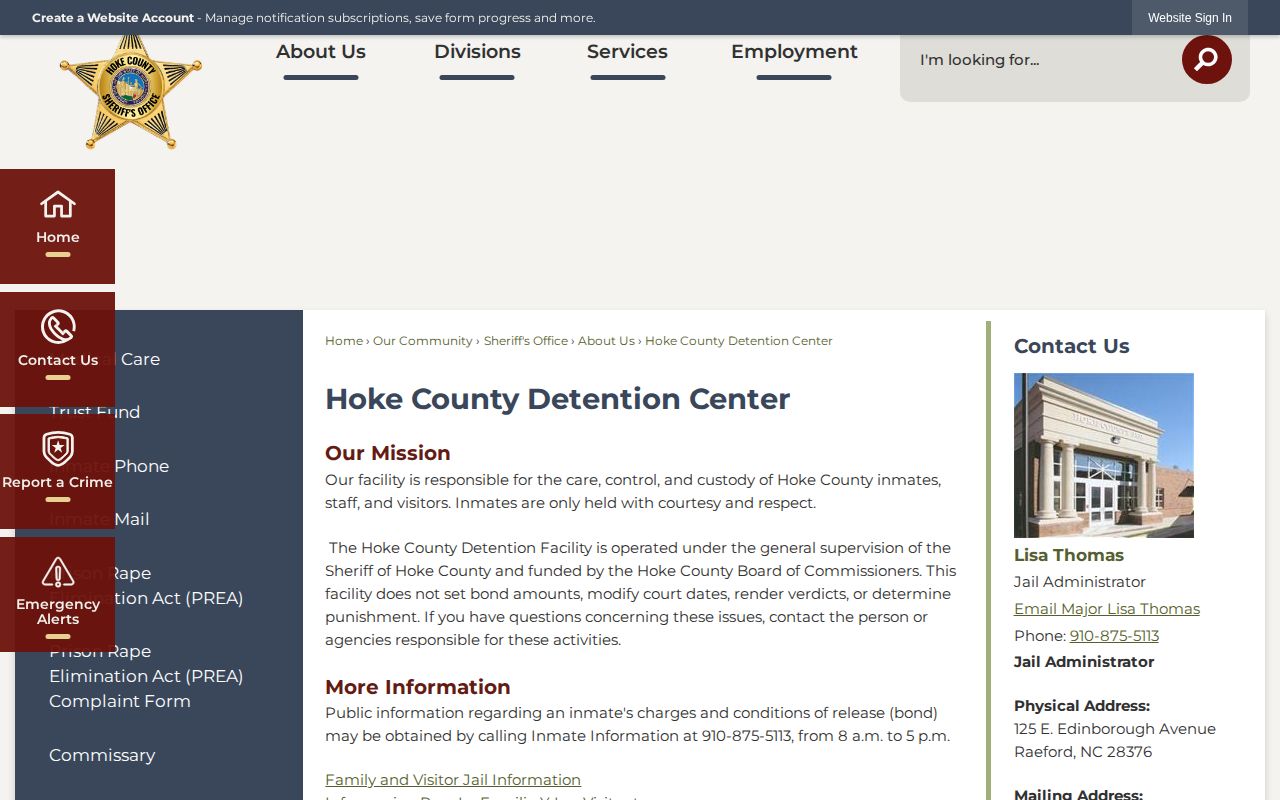
The official jail page shows a phone-first process, not an online roster.
Roster status is temporary. Release, transfer, court action, or a move to another custodian can drop a name from the active jail population. The arrest report and booking record can outlive that listing. So the request chain shifts with time. Start with current-custody channels for anyone held now. Turn to the arresting agency and the clerk for an older event. A state-prison sentence moves the trail to NCDAC. Each step answers one question. No single result is a full criminal case history.
Where Hoke County Arrests Appear
Each channel covers a different custody stage. The jail line and sheriff app handle county custody. The Judicial Branch carries the court case. NCDAC covers state prison, probation, and parole, not the county jail. Federal BOP and ICE locators play narrower roles, while commercial pages may copy booking details yet lag, omit corrections, or keep a record alive after release.
| Channel | Photo status | Authority | Access |
|---|---|---|---|
| Detention Center | No web-photo policy published | Official county | Call 910-875-5113 |
| Sheriff app | Not promised by listing | Official agency app | Apple App Store or Google Play |
| NC court Portal | Not a mugshot source | Official court | Search cases and visit clerk terminals |
| NCDAC offender search | May show offender image | Official state | Name or offender ID search |
| Local news | Editorial, if used | Independent news | Selected incidents, not a roster |
| Commercial booking pages | Often, where supplied | Unofficial | Verify every field with the originating office |
Recently Booked runs an unofficial Hoke section and says it refreshes a rolling window of recent arrests. Busted Newspaper has a Hoke County section too. Mugshots.com carries a county category. Its Hoke page loads unevenly, though. Arrests.org shows no Hoke-local section. Mugshots.zone does not either. Treat these as leads only. A commercial entry can lag or persist after release, so it never settles current custody.
Hoke News and regional outlets like WRAL, North State Journal, and WWAY publish selected public-safety stories. News judgment helps with context. It fails at completeness. A major operation may get ink while routine bookings go unmentioned, and an editorial photograph is not always the booking image. Sheriff press releases also pick and choose. Save the source, date, and agency named in the article, then chase the official report or court case. That habit separates a news account from the government record behind it.
Recent Arrests in Raeford
Raeford is Hoke County's only incorporated city. Its police department handles city matters. The Sheriff's Office patrols the rest of the county and operates the jail. Some city arrests end with booking at the Hoke County Detention Center. The Raeford Recent Arrests page explains how to identify the arresting agency, request a city police report, and follow a county booking. It does that without inventing a city blotter that does not exist.
The split is more than a label. Raeford Police publishes a non-emergency number and takes record inquiries through city channels. The city site has no arrest log. No mugshot gallery either. County tools matter only when the event produced a county booking, and a citation or a magistrate's release may never reach custody channels. Historical News-Journal issues even ran Raeford Police Blotter and Sheriff Blotter columns separately. So name the agency before requesting any report.
Inside a Hoke County Arrest Record
A booking record documents intake after an arrest. Hoke County may hold the record anyway. It publishes no public browser roster. Fields vary by source, and a court file can change after the intake entry. Find the right person with identifiers, then check the disposition for the outcome.
| Field | What it means |
|---|---|
| Name and descriptors | Identity details recorded by the booking agency |
| Booking date and number | The intake event and its local identifier |
| Arresting agency | The office responsible for the arrest report |
| Charges | Accusations entered at booking, subject to later change |
| Bond or release condition | The current judicial terms reported to the jail |
| Booking image | An identification photograph if one was taken and may lawfully be released |
| Court date or case number | A bridge to the court calendar and final disposition |
- Booking
- The jail intake process after an arrest.
- Bond
- A court-set condition that may permit release.
- Disposition
- The result of a charge in court.
- Expunction
- A legal process that removes qualifying records from ordinary public access.
Every channel shows a different slice. The detention line covers current charges and release conditions, nothing more. A police report tells the story of the event itself, naming the officers who responded. A booking sheet logs the intake into jail. A court case adds filed charges, hearing dates, orders, and the final result. Dates deserve care. Arrest time, booking time, first appearance, and release time are four separate events. Bond works the same way. A booking display may show a condition entered in that moment. A later court order can change it.
Hoke County Mugshots and Arrest Photos
Hoke publishes no gallery of every booking photo. A missing image online does not mean no photo was taken. North Carolina law lets officers photograph and fingerprint people in certain charged-and-custody situations. Whether an image becomes public turns on public-record law, investigative limits, the file, and custodian policy. So ask for the photo tied to one named booking. A broad photo list is the weaker request.
Once a person enters the state prison system, the NCDAC Offender Public Information search may show an offender image. That is state custody data. State prison is not county jail. It cannot confirm a Hoke jail stay. Commercial sites republish booking photos, and their copies can lag behind a dismissal, expunction, or release.
A booking photo is an identification record made during processing. Hoke posts no page promising that every image is online, that app results include one, or that photos stay up for a set time. Keep the request narrow. Give the name, date, arresting office, and local number. Then ask whether an identification photograph exists and which law or policy governs access. If the office withholds or redacts something, ask for the basis and the separable public information. Don't assume the rest is closed. The official NCDAC search interface is a separate state lookup. Use it for state custody questions.
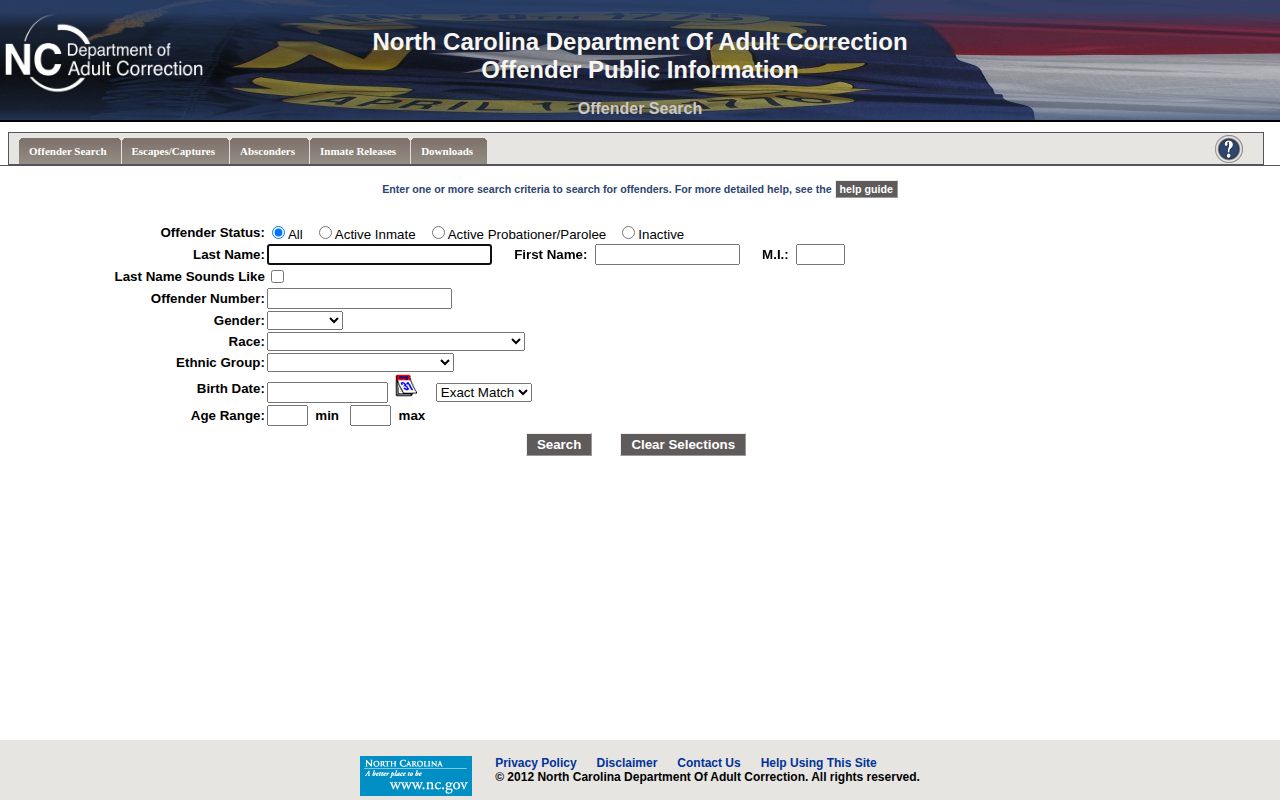
Use it for state prisoners and parolees, not for Hoke County booking confirmation.
Request a Hoke County Arrest Record
The Sheriff's Office posts an Incident Report Request form. It asks for your contact details and everything you know about the event. An OCA or case number helps, along with the location, date, time, and any victim or offender details. The form targets incident reports, not booking photos. For a booking sheet or image, name the exact record and confirm the form is the right route. Hoke sets no fixed booking-photo fee or response time.
- Collect the full name, approximate arrest date, arresting agency, and any OCA, booking, or court number.
- Check current custody through the app or detention line before requesting a retained record.
- Submit the official incident form or contact the Sheriff's Office and name each item sought.
- Ask about cost, format, redactions, and timing before ordering copies.
- Use the court case number to check the disposition and any expunction order.
The official Hoke incident-request form shows the details that help staff locate an event.
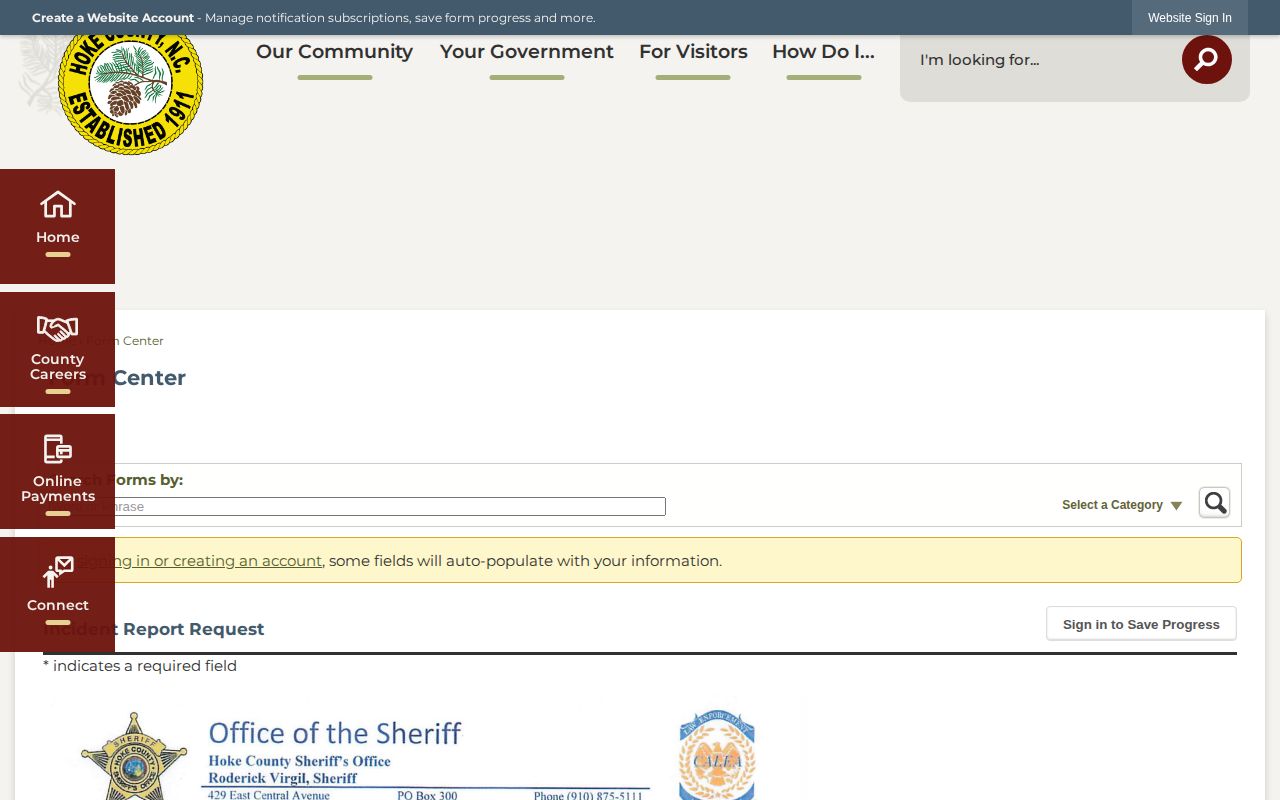
An OCA number can narrow a search. Requesters may still need to say plainly that a booking record or photo is wanted. The OCA, or originating case agency number, links a request to the agency's own event, which makes it the strongest identifier. A court file number belongs to a different system and may not pull the incident report at all. State your preferred format. Ask whether inspection is possible before paying for copies. Keep your submitted form and the agency's response.
Split requests by custodian if the matter spans Raeford Police and the Sheriff's Office. The police hold the city arrest narrative. The Sheriff's Office holds jail intake and detention material. One focused request per office beats asking an agency to produce another agency's records.
Hoke Arrest Records Under State Law
North Carolina G.S. 132-1.4 governs criminal-investigation records and lists the arrest-related information that stays public. The statute does not open every investigative file. Juvenile, sealed, expunged, protected, and active-investigation material follows different rules. No statewide law bans county booking-photo publication outright. House Bill 446 proposed restrictions in 2025. Its official history shows no enactment.
State retention schedules cover arrest reports, intake tracking, detention rosters, and identification photographs. They set retention or disposal by record series and case-file status. A schedule never proves Hoke still holds an item. Litigation or an audit can suspend destruction. Ask the Sheriff, the clerk, and the State Archives by series, identifier, and date. The schedules draw helpful lines. Sheriff arrest-processing records can include arrival and workstation times. Arrest reports may hold names and descriptors. Alleged offenses and officer information may appear too. Detention records can include rosters, commitments, releases, and cell accountability. A photo follows one path when kept separate. It takes another when filed into a felony or misdemeanor case. For an old event, list every plausible series in the request. The State Archives can help with transferred historical court or county material. It lists no digitized Hoke jail mugshot collection. Archives are not a fast route for a new booking. The official General Statute 132-1.4 page carries the text behind this access discussion.
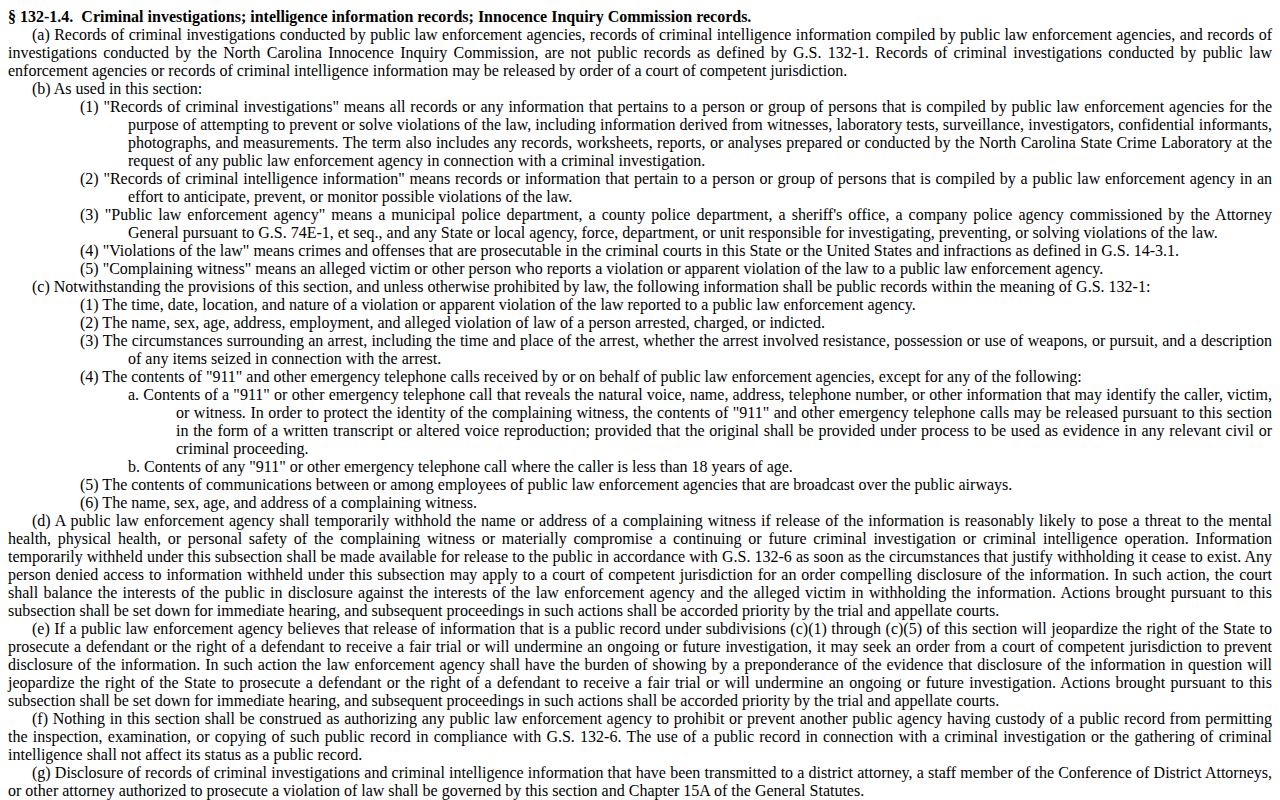
Weigh the statute, the facts, and any court order.
Correcting Hoke County Arrest Results
A booking charge and a court outcome are two different things. When a Hoke County arrest record needs fixing, start at the source. The Hoke court file controls, and a certified order carries the most weight. That matters for a dismissed charge. An expunged record or an acquittal counts too. North Carolina G.S. 15A-146 and the Judicial Branch expunction resources lay out the paths that qualify. Fix the government record first. Only then ask a search engine to refresh a stale result.
Some private sites publish arrest information without asking anyone. Many offer a free correction form. It works for a wrong-person entry or a duplicate. A juvenile record and a dismissed charge count too. Use that free process for corrections, and keep copies of everything you send. Be skeptical of paid cleanup services. No company can wipe a government file. Nor can it clear every search engine and every copied database at once. A record that is accurate and still public may lawfully remain online.
Corrections and expunctions are not the same tool. A correction repairs a wrong field or a mismatched person. Expunction is a court process under statute. A publisher's own removal policy is a third, separate thing. North Carolina G.S. 15A-152 covers a state notice process aimed at certain private criminal-history publishers. However, it creates no universal photo takedown right. Match your proof to your request. Send an ID for a wrong-person claim. Send a certified disposition for a dismissal, or the expunction order itself. Never hand over more sensitive data than the documented process demands.
Hoke County Arrest Warrants
Hoke County publishes no online warrant search and no current most-wanted roster. The Sheriff's tip form does include a "Location of Wanted Persons" category. However, it cannot confirm whether a warrant is active. The Unsolved Cases page handles missing-person and cold-case matters. It is not a wanted list. For a question about your own warrant status, talk to a lawyer or the court about it. Resolve it the safe, lawful way. The Sheriff's non-emergency line is 910-875-5111. Never confront someone you believe is wanted. Route safety tips through the official channel. Call the anonymous tip line at 910-878-1100 when it fits, and dial 911 in an emergency. Warrant status can shift after service, recall, or court action.
After a Hoke County Arrest
The detention center knows who is in custody. It does not set bond, move court dates, or decide punishment. Hoke joined North Carolina's eCourts system in October 2024, so a case can be tracked through the Portal, criminal calendars, clerk terminals, and the courthouse file. The Hoke County Courthouse sits at 304 N. Main Street in Raeford. Its main number is 910-878-4100.
A disposition is the recorded result a court enters. Compare it against the original booking rather than assuming intake tells the full story. The clerk holds the court records. The investigating agency holds its own police report. One office may carry the outcome but lack the arrest narrative or image.
Public terminals and paper case files often hold details a thin online result skips. The Judicial Branch warns that copies may carry a fee. Criminal calendars show upcoming settings, but they promise nothing about the final result. Write down the county, the file number, and the defendant name. Add the charge. That keeps later checks tied to the right case. If the court record shows a dismissal or a reduction, use that later entry. The booking charge stays part of intake history. But it should never be passed off as the court's last word.
Hoke County Bond Information
Hoke County posts no public bond schedule. The detention center can tell you current release conditions, including bond. It does not set them. Ask jail staff what the custody record shows. Take legal questions to the magistrate, the court, or counsel. Never assume a standard amount from another county or an unofficial site. Terms can change after a hearing.
Release conditions can involve more than a dollar figure. The jail simply reports what the judicial order requires right now. Staff cannot rewrite that order or shift a court date. A commercial site may list a bond number from an earlier stage. Weigh any number against the current jail record. Check the filed court order too. Families arranging a lawful release should follow the instructions from the jail, magistrate, or court. Questions about how an order applies belong with a lawyer, not a booking publisher.
Hoke Arrest Data Is Not a Roster
Hoke County arrest information does not arrive as one tidy list. The SBI's 2024 viewer treats the Hoke County Sheriff and Raeford as two separate reporting agencies. Its Uniform Crime Reporting figures are aggregate measures. An offense count is not a booking count. Sheriff's patrol logs can document activity without proving each event ended in detention.
Agency attribution matters. A Raeford police event starts with the city department. A Sheriff's event starts with the county office. If either arrest leads to jail intake, the detention record moves through Hoke's jail system. That handoff can leave related records with two offices.
The county Services page links an external Google Drive folder labeled Patrol Logs. The label matters. A patrol log can show calls, dates, locations, or officer activity depending on the file, but it is not a booking feed. The Sheriff's news area is also event-based. Combining these sources into a supposed daily arrest list erases the limits each one has. Treat a patrol entry as a way to identify the agency and approximate the event. Then confirm whether an arrest and jail intake actually occurred. Use aggregate SBI figures for broad agency context only, never to name or count current inmates.
Custody Beyond Hoke County
Custody searches reach beyond Hoke County. NCDAC's public search covers state prisoners, probationers, parolees, and correctional records going back to 1972. County jail information is excluded. The Federal Bureau of Prisons locator covers federally sentenced inmates from 1982 forward, not county pretrial custody, and it is not a mugshot gallery.
Search NCDAC by name or offender ID. Compare any result against the Hoke court case before assuming two similar names belong to one person. A state record can show correctional status long after the county intake phase. Probation or parole is community supervision. BOP results likewise describe only the federal system. County, state, and federal identifiers are not interchangeable, and a transfer can leave a gap where one system has closed its record before the next public interface reflects the move.
ICE's Online Detainee Locator covers specified immigration custody. It can omit juveniles or people still being processed. A missing ICE result is not proof of release. So choose by custody stage. The options: newly booked or locally held in Hoke, released with a retained local record, sentenced to NCDAC, federally sentenced in BOP, or held in immigration custody.
Verify Hoke County Arrest Information
Start with the source nearest the event. The arresting agency holds the incident report. The Hoke Detention Center handles current county custody and release conditions. The clerk and eCourts show the filed case. NCDAC, BOP, and ICE apply only when custody moves into those systems. That order keeps a stale copied page from being mistaken for a live jail result.
Hoke's online gaps are real. The county publishes no public HTML roster. There is no official booking feed, no fixed photo policy, no online warrant database, and no published booking-photo price. Phone calls, the app, a focused request, and court follow-up form the sound chain.
Keep a simple search log. Note the full name used, spelling variants, source, date, time, and any number returned. Save the government response and later court disposition together. Never merge conflicting facts into a new claim. Ask the originating office to clarify. For a released person, a blank inmate result may be correct even though the arrest record remains. For a sentenced person, a state result may be current even though Hoke no longer lists custody. Clear labels preserve that timeline and reduce the harm stale information can cause.
Official contact routes can change. The linked county, court, state, and federal pages remain the places to confirm live procedures. Never assume an old screenshot proves current hours, policy, or access. Current agency text and direct confirmation control.